



Cheap web hosting for a small business should be compared over the full billing term. Add the hosting payment, domain, email and required extras, then calculate the renewal term separately.
A low introductory rate can become less attractive once domain renewal, extra email accounts or paid backups are included. Use the worksheets below to compare those costs against your website’s requirements.
Compare the full cost and included services before committing.
Key Takeaways
- Compare the prices you’d pay over the same term.
- Account for the cost of a domain name, email, backups, security, migration and relevant taxes.
- Think about the resources and expected traffic your website will need to host.
- Check available support, backup restoration, and resource limitations.
- Anticipate costs of website upgrades.
What does cheap hosting actually cost?
While low prices do not always indicate low quality, hosting can become extremely poor value for money for a number of reasons. It can seem cheap at first, but the prices may exclude essential services that you ultimately end up paying more for. One of the better ways of comparing hosting services is to include all the costs involved with running a website.
Separate One-Time, Recurring, and Conditional Costs
Different expenses do not occur at the same time, and accounting for frequencies can further improve your budget.
One-time costs: These include the costs associated with initial website migration, setup or other assistance charged only once.
Recurring costs: These costs include hosting fees, domain and email renewals, and other support or service costs charged repeatedly.
Conditional costs: Depending on the success and growth of your website, you may have to pay for more storage or additional services.
Taxes and fees: These are the additional costs that are charged at the time of purchase that are not included in the advertised price.
Not all of the costs you pay for are necessary.
Calculate First-Term and Renewal-Term Totals
To simplify comparison of various hosting services, use the following formulas over the same period of time.
First-term total = Total cost of the first term of hosting + domain + email account + necessary add-ons + one-time fees + taxes.
Renewal-term total = Total cost of renewal term of hosting + domain and services + necessary recurring add-ons + taxes.
You must separate one-time costs when anticipating costs for the future. Also check if your domain and hosting renew on different dates, because their renewals may not occur in the same billing cycle.
Use UltaHost as a Worked Example
UltaHost provides an excellent example of why buyers should always verify published prices and billing terms instead of relying on a lone monthly price.
On 2 November 2026, the UltaHost shared hosting page listed Shared Starter at $3.44 per month on the 24-month option, with the same displayed rate for the next 24 months. At that point the page listed 1 website, 30 GB NVMe storage, backups and an SSL certificate. Use these figures as a worked example and check the selected term at checkout for the current offer.
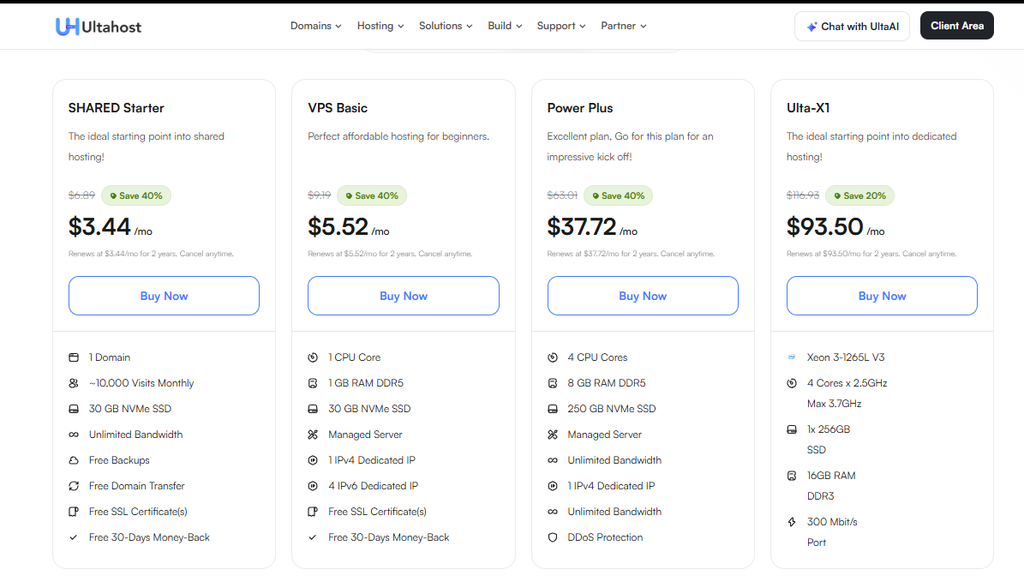
At the stated promotional rate, $3.44 × 24 months = $82.56 for hosting before tax and extras. The plan price and renewal terms still need to be checked against the selected billing option.
The above-stated cost is for 2 years of hosting, before any taxes or additional services are added. This does not represent the total cost of running a business website.
The price customers see must always be the starting point for comparison. Be sure to confirm the final price, payment terms, and renewal rates before purchase.
Essential Features for a Business Website
When looking for an affordable small business web hosting company, you should look for a provider that offers the services necessary to keep your website available, secure and manageable. This doesn’t mean you should look for the shortest feature list. The feature list of a plan should be adequate to cover the needs of your business.
Reliability and Technical Support
Your website may be the main source for your customers to look for your hours of operation, services, contacts, or bookings.
Check the cancellation process, refund eligibility, and deadlines before committing to a long billing term. Confirm applicable taxes and whether the checkout amount differs from the advertised monthly equivalent. These details help you understand the financial commitment rather than relying on the headline price alone.
SSL, Security, and Backups
The SSL certificate is needed to establish an encrypted connection between your website and the visitor’s browser. This is the basic requirement for data protection; however, SSL alone will not protect against malware infections, cracked passwords, and other dangers.
See what SSL certificates, security monitoring, malware protection, and backups are offered by the hosting provider.
Storage, Resources, and Website Limits
Storage indicates the amount of disk space that you can use to store website files, images, databases, and other content. CPU and RAM usage or allocation limits might also affect performance if the website receives a traffic spike.
Check the amount of websites allowed, database allowances, storage, as well as other possible resource limitations. Do not think that an “unlimited bandwidth” label implies unlimited resources of all kinds.
Select a package which will meet your needs without buying unnecessary capacity.
Business Email and Staging
The email account associated with your domain name may be useful for forming a unified business image. Make sure how many email accounts are provided in the package and what is their cost.
Staging is an option which enables testing of website modifications prior to publishing them. It may be especially helpful for a WordPress website which often installs new plugins or updates its themes and functionality. It will not be necessary for a simple website updated infrequently.
There are various types of hosting each designed for a particular purpose. Selecting a proper one is the key to avoiding excessive spending and providing some flexibility for the future.
In shared hosting multiple websites reside on one server that is sharing computing resources. The hosting company takes care of the hosting environment which makes this type easy to use even for a beginner.
Shared hosting may suit portfolios, local restaurant websites, consultancy pages and other small informational sites when the selected plan meets their resource and feature requirements.
Learn more about UltaHost shared hosting and learn what shared hosting is to get familiar with the concept prior to choosing a plan.
Hosting for WordPress
Hosting for WordPress is designed for websites that run on WordPress and might involve management, optimization, or automatic processes for this particular platform. Exact details depend on the hosting provider and selected plan.
Learn about UltaHost Hosting for WordPress if you operate a business website running on WordPress.
VPS Hosting
Virtual private server (VPS) offers a dedicated virtual environment and, depending on the hosting service provided, might involve extra management skills.
Yet, VPS is not necessarily better for any small business. Pay attention to extra costs, management efforts, security measures, and support involved in the process. Learn more about UltaHost VPS hosting if needed.
How to Compare Two Hosting Plans Fairly
The most helpful hosting comparison involves the same requirements analyzed during the same period of time. It is not fair to compare the two-year promotional subscription with the monthly plan unless you take into account different obligations.
Follow a Consistent Comparison Method
Step 1: Compare the billing periods. It is important to compare similar periods of time and verify whether the presented monthly price is subject to prepayment.
Step 2: Note the renewal rate. Find out the price of the following period and the terms which affect renewal price and discounts.
Step 3: Compare website requirements. It means comparing the number of websites, space, databases, resource limitations and compatibility of platforms.
Step 4: Confirm inclusion of services. It includes verification of the eligibility for the domain name, email, SSL, backups, restoration, migration and support.
Step 5: Include required additional services and taxes. Only necessary additional services should be taken into account if they are really required to launch your business website.
Step 6: Compare the contract terms. It means verifying the cancellation policy, possibility of refunds, renewal options and other terms which can influence the choice.
Comparison worksheet
| Cost or feature | UltaHost SHARED Starter | Namecheap Stellar |
|---|---|---|
| Introductory price per month | $3.44 | $1.88 |
| Billing period | 24 months | 24 months |
| 24-month estimate from monthly rate | $82.56 | $45.12 |
| Published renewal price | $3.44/mo for 2 years | $102.88 for 2 years |
| Next 24-month hosting estimate | $82.56 | $102.88 |
| Domain | Free domain transfer | Free domain for 1 year only |
| Security | Security features listed by UltaHost | Imunify360 and automatic SSL listed |
| Storage | 30 GB NVMe SSD | 20 GB SSD |
| Websites | 1 | 3 |
| Taxes and other charges | Verify at checkout | Verify at checkout |
Pricing snapshot from 2 November 2026 (USD). The examples use the 24-month UltaHost Shared Starter offer and Namecheap Stellar in the US on bi-yearly billing with the free trial off. Monthly rates multiplied by 24 are estimates. Check each provider for the current upfront and renewal totals before buying.
Monthly prices may be rounded or promotional, so compare them with the actual amount payable for the full billing period. For example, $1.88 multiplied by 24 months equals $45.12. If a provider’s checkout shows a different total, divide that actual payment by 24 to calculate the effective monthly cost. Also compare renewal prices separately, because introductory and renewal rates may differ. Prices should be verified on the provider’s official website or checkout page on the date of publication.
The cheaper choice is the plan that suits your needs in a sustainable way rather than one with the lowest introductory price.
Cost Worksheet
Use the worksheets below to add the actual quote for your chosen domain, email and backup requirements. A free transfer offer does not mean a new domain registration is included. Included email and backups may cost nothing extra only if their limits meet your needs; paid services and taxes must be added before comparing totals.
For UltaHost:
| Cost Item | First 24 months | Next 24 months |
|---|---|---|
| Hosting subscription | $82.56 | $82.56 |
| Domain registration/renewal | Add selected domain quote | Add selected renewal quote |
| Required business email | Add cost if not included | Add cost if not included |
| Paid backups | Add cost if not included | Add cost if not included |
| Applicable taxes | Excluded | Excluded |
| Total cost | Hosting plus quoted extras and tax | Renewal plus quoted extras and tax |
For Namecheap Stellar
| Cost Item | First 24 months | Next 24 months |
|---|---|---|
| Hosting subscription | $45.12 | $102.88 |
| Domain registration/renewal | Add selected domain quote | Add selected renewal quote |
| Required business email | Add cost if not included | Add cost if not included |
| Paid backups | Add cost if not included | Add cost if not included |
| Applicable taxes | Excluded | Excluded |
| Total cost | Hosting plus quoted extras and tax | Renewal plus quoted extras and tax |
Common Hosting Costs and Limitations to Check
Even a budget-friendly plan will prove to be costly if its constraints are not aligned with your business needs.
Domain Renewal and Email Seats
An offer of the domain will only apply to specific extensions or the valid registration period. Check its renewal price and whether the domain charges are billed independently of the hosting.
Backup Retention and Migration Scope
Make sure to find out whether backups occur automatically, how often they happen, and how long the backups are stored for. The usefulness of the backup feature depends largely on the retention period.
Resource Policies and Upgrade Costs
Terms like unlimited bandwidth do not mean that you can use unlimited server resources. Check out the relevant policies on usage and what would happen if your website goes beyond the allowed limits of its hosting plan.
Also, when choosing the hosting plan, check out the next available hosting plan just in case you might require a bigger one. It is possible that an affordable entry-level hosting plan is enough if the provider has a reasonable upgrade system.
Cancellation, Refunds, and Taxes
Check out the cancellation terms, possibility for refunds, deadlines and tax issues as well. These terms allow you to see how much you are paying in comparison with the advertised monthly rate.
A Small-Business Web Hosting Purchase Checklist
Before making the final decision, consider the following questions:
- Does the plan support the website platform I am using? How many websites does the plan support?
- What is the entire cost of the first term?
- What is the renewal price for the same billing period?
- Is my domain included, and what is the cost of its renewal?
- Are the included email accounts enough for my organization?
- Do the included SSL certificates, backup services, and restoration provisions suit me?
- What technical support is there if my website fails to work?
- Are migration services, resource limits, cancellation policy, and refund conditions provided?
- What does an upgrade cost if my website requires a higher plan?
- Have I included all necessary add-ons and taxes?
Answer these questions in order to make the final decision. Start with shared hosting if your website is simple and the hosting plan suits you. Go with Hosting for WordPress if your website needs special features that are platform-specific. Choose a VPS if you can determine some specific resource or configuration requirement.
The most suitable purchase is one where there is a good balance between important features, affordable prices, and reasonable potential for development.
Final Thoughts
Selecting a cheap web hosting service for your small business is not just about choosing the hosting service with the cheapest prices on its website. You need to choose one that provides all the necessary functions needed by your site at a price that you will be able to afford even after the initial period of hosting services has passed.
Shared hosting packages offered by UltaHost can serve as a good choice for a cheap web host for small businesses. Nevertheless, do your research on other providers using the same billing cycle and having the same conditions for websites as yours. This will help you calculate the costs of choosing the most affordable yet still good web host.
FAQs
Can cheap web hosting suit a small business?
Yes. Budget hosting can support many small-business websites, such as portfolios, service websites, blogs, or smaller company websites. Suitability is based on the host’s reliability, available resources, security measures, and actual workload of the site.
Is free domain included in cheap web hosting?
Some plans include a domain offer for eligible extensions and an initial term. Check whether it covers registration or transfer, and confirm the renewal charge separately.
Does small business hosting come with email and SSL?
SSL certificates are included in most plans, but the number of included email accounts varies. Some plans come with a limited number of mailboxes, while some require extra purchases or use of another email provider.
How expensive is cheap web hosting upon renewal?
This depends on the plan, time of billing, and renewal terms. Find the renewal rate per month/quarter/year and multiply it by the renewal period. Also, don’t forget about renewing domains and other necessary fees.
When should a company consider upgrading hosting?
One should think about upgrading when their website frequently exceeds its limit, is too slow even after optimization, needs more storage space, and cannot have particular functions due to current plan.


